Code, Crops, and Capital
The Modern Feudalism of India’s Agri-Tech Boom
TECHNOLOGYFEATUREDINDIA
7/6/20263 min read
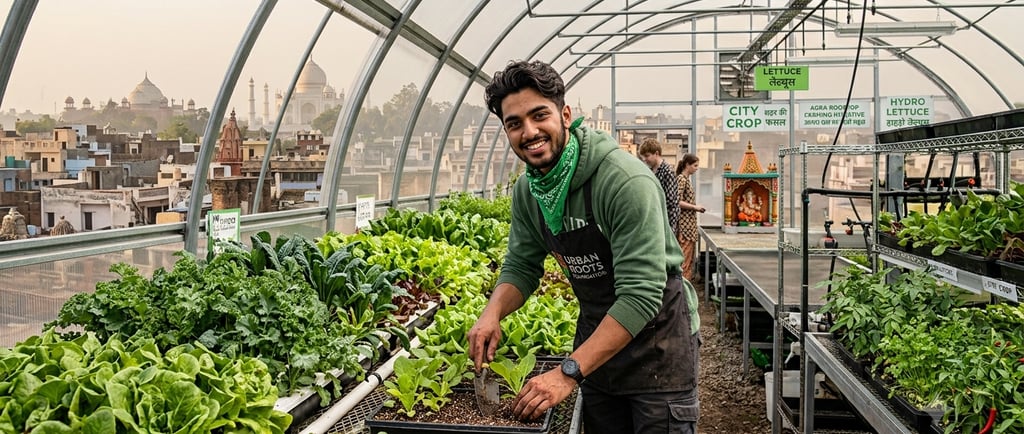

The landscape of Indian agriculture is undergoing a quiet, high-tech transformation. On the fringes of tier-1 and tier-2 cities, traditional monoculture fields are increasingly replaced by automated glasshouses, solar-powered aquaponic systems, and precision indoor vertical racks. This high capital expenditure (Capex) infrastructure is not being built by traditional farmers. Instead, it is funded by an emerging class of affluent urban professionals, corporate retirees, and middle-class investors seeking passive income, tax exemptions, and a personal "back-to-the-farm" lifestyle.
To operate these complex installations, urban owners are bypassing standard manual labor. They are hiring educated, literate rural youth who are unwilling to handle traditional manual farming on their family plots but eagerly accept structured, salaried roles like "Farm Manager" or "Agri-Executive."
While this dynamic is currently in an optimistic "honeymoon phase," it masks a structural trap. The convergence of urban capital, strict contract law, finite planetary boundaries, and rigid high-value crop economics is quietly recreating a modernized system of feudal exploitation. In this system, technical and economic success inevitably precipitates systemic collapse.
The Anatomy of Risk Transfer
Traditional smallholder farming in India is paralyzed by fragmented landholdings (averaging just 1.08 hectares), an inability to mechanize multi-tiered ecosystems, and severe rural labor shortages. To bypass these barriers, affluent urban investors utilize their substantial capital to cultivate specialized, high-cash luxury crops—such as indoor saffron, blueberries, asafoetida (hing), and exotic mushrooms.
Because these investors possess little to no practical biological experience, they rely entirely on the technical literacy of hired village youth to calibrate automated nutrient flows, manage HVAC systems, and monitor crop health. However, the corporate hierarchy established by this relationship introduces a severe operational imbalance:
Affluent Urban Investor ──>Deploys High Capex──>Automated Infrastructure
↓↓
Production Interruption
↓↓
Paranoia & Digital Oversight ────────>Blames "Educated Youth" Tenant
↓↓
Withholds Pay / Initiates Lawsuit ──────> Youth Faces Legal & Debt Crisis
When biological anomalies inevitably occur—such as substrate contamination or an equipment failure causing a sudden crop disease—the urban investor routinely treats the natural setback as an executive failure by the youth worker.
The Rise of Digital Infrastructure Feudalism
When these high-Capex operations encounter persistent biological variations, less resilient urban investors seek to insulate themselves from ongoing operational expenditures (Opex). To avoid booking a complete capital loss on fixed assets like automated greenhouses, they stop acting as direct operators. Instead, they pivot to becoming pure rentier landlords.
They lease their advanced facilities to the local village youth for a fixed, monthly rental fee, shifting the entire production and financial risk to the worker. The local youth, lured by the prospect of running a high-tech facility without taking out a massive infrastructure bank loan, borrows money from informal local networks to fund expensive inputs like tissue-culture plants or liquid nutrients.
This relationship is codified through precise Commercial Lease Agreements or Service Level Agreements (SLAs). If the crop fails or municipal utilities fail, the urban landlord—who remains insulated in the city—still demands the fixed rent. When the tenant defaults or a crop is lost, the landlord leverages their superior financial resources to initiate formal lawsuits for breach of contract.
This updates the asymmetries of colonial-era crop contracts. The state's legal machinery is utilized by an urban elite to discipline and extract wealth from a vulnerable rural worker whose own literacy has been used to bind them to a legal liability.
The Success Paradox: Market Saturation and Overproduction
The long-term threat to this system is not its failure, but its potential scale. High-Capex agriculture relies entirely on maintaining artificially inflated luxury price points to recover initial capital investments and offset rigid operational costs.
However, we operate on a single planet with a strictly finite consumption capacity; agricultural surpluses cannot be exported to external planetary vents. When thousands of urban micro-investors successfully replicate these high-tech systems around metro peripheries, they create an immediate localized supply shock.
Production Success ──> Local Supply Glut ──> Retail Price Collapse
↓↓
Landlord Insulates Income <---- Fixed Rent Squeeze ----> Opex Exceeds Market Value
When the market shifts from scarcity to a heavy surplus, retail prices crash. A luxury commodity can quickly drop below the value required to cover basic daily Opex (like electricity and technical nutrients). To protect their margins, landlords inevitably compress the worker’s income or maintain high lease rates, driving the tenant youth into insolvency.
Conclusion: The Secondary Displacement
This progression demonstrates that under a purely market-driven framework, the absolute success of agriculture ensures its systemic demise. By transforming a localized, lifestyle-based subsistence practice into an unregulated corporate sweatshop, the model strips away traditional agrarian resilience.
Once the profit margin collapses under the weight of overproduction, urban investors write off the structures as a tax loss and abandon the city peripheries, leaving behind a landscape of rusted polyhouses and over-pumped aquifers.
The educated village youth, having spent their prime years mastering non-transferable boutique technologies while losing touch with traditional farming methods, are forced to migrate into urban centers. However, they do not enter as skilled technical workers; they are absorbed into low-wage urban gig economies as delivery riders or warehouse packers.
Ultimately, the technical and economic success of the high-Capex model dismantles the remaining foundational elements of the agrarian fringe, resetting the cycle of rural displacement in a more predatory, digital, and irreversible form.